



By Burnett Munthali
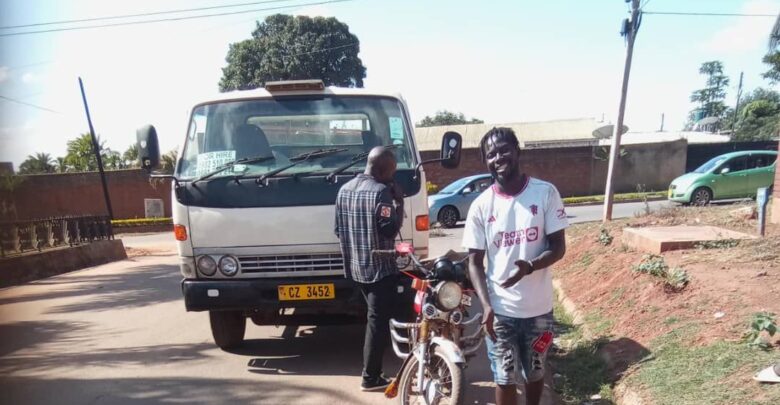
On Tuesday, 29 April 2025, a road accident occurred in Area 2, Lilongwe, involving a truck and a kabaza taxi motorbike.
The incident has reignited conversations about road safety, traffic rule enforcement, and the daily challenges faced by motorcycle taxi operators in Malawi.
According to eyewitnesses, both the truck registration CZ 3452 and the motorbike were travelling in the same direction when the accident happened.
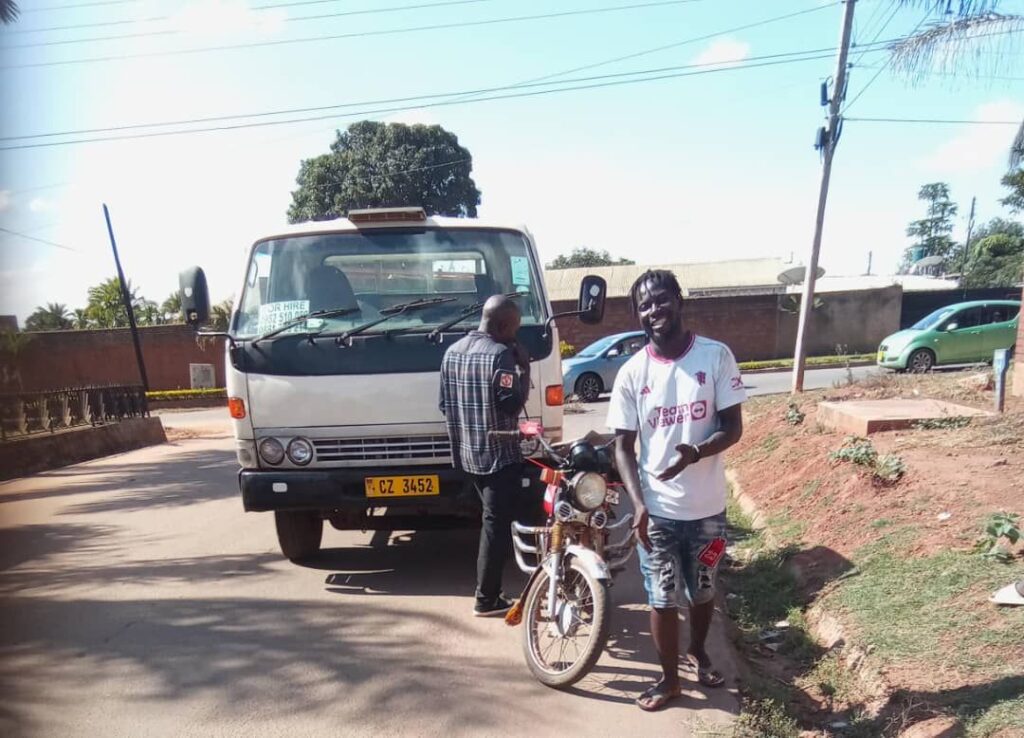
As the truck began to slow down and indicate a stop, the motorbike rider attempted to overtake from the left side.
In the process, the motorbike collided with the truck, hitting the passenger door on the left side.
This point of impact suggests that the kabaza rider may have misjudged the truck’s intentions or failed to slow down in time.
This reporter arrived at the scene just moments after the accident had occurred.
It was evident that the situation had drawn a small crowd of bystanders and concerned residents.
Upon conducting interviews with those involved, the motorbike operator blamed the truck driver for not checking his rear-view mirror before stopping.
The kabaza rider insisted that had the truck driver looked behind, he would have seen the approaching motorbike and adjusted accordingly.
The truck driver, who remained at the scene but was visibly shaken, declined to comment at the time.
However, other drivers present shared differing views, with some arguing that the motorbike rider should not have been overtaking from the left, especially in a stop zone.
This incident has raised critical questions about traffic regulations and the extent to which they are observed by both motorcyclists and drivers of larger vehicles in Malawi.
According to Malawi’s traffic laws, overtaking is strictly prohibited on the left side unless the vehicle ahead is making a right turn and it is safe to do so.
The Road Traffic Act also requires that all drivers, including those operating motorcycles, observe clear safety distances, signal intentions clearly, and avoid reckless manoeuvres.
It is clear from this accident that there is a widespread lack of adherence to these basic traffic rules, which poses a growing risk to road users.
The situation is worsened by the fact that many kabaza operators either do not hold valid licenses or lack formal training in road safety.
Motorbike taxi services, while convenient and affordable, are often loosely regulated and operate under challenging conditions.
Most kabaza riders work long hours without protective gear and face intense pressure to complete as many trips as possible in a day.
This, in turn, leads to increased risk-taking behaviour on the roads, including speeding, overtaking in unsafe zones, and ignoring traffic signs.
Some road safety advocates have repeatedly called on government authorities to introduce stricter training and licensing systems for motorcycle operators.
They argue that improving the safety culture among kabaza riders is essential to reducing the number of road accidents in urban areas like Lilongwe.
In addition, poor road infrastructure and lack of designated lanes for motorcycles exacerbate the problem.
Many roads in Malawi’s cities are not designed to accommodate the growing number of motorcycles and have inadequate signage and road markings.
This makes it even harder for drivers and motorcyclists to anticipate each other’s movements and avoid collisions.
While the Area 2 accident did not result in fatalities, it serves as a reminder of the fragile state of road safety in the country.
It is also a call to action for policymakers, law enforcement agencies, and road users themselves to take greater responsibility.
Without firm steps to address the challenges facing motorbike operators and enforce traffic laws more consistently, such accidents will continue to rise.
Ultimately, road safety in Malawi is not just a matter of law but a shared responsibility that requires public education, infrastructure investment, and behavioural change.